Author: Joey

  • On Economic Exploration

    On Economic Exploration

    If you read The Civilian Noninstitutional Population post, you might have wondered… where is all of this coming from?

    Why is this guy talking about economics, and why should I bother reading it?

    Well, this new series of posts I’ve started are directly picking back up on economic studies I developed back in 2008-2011 as part of my conceptual art think tank, Ape Con Myth.
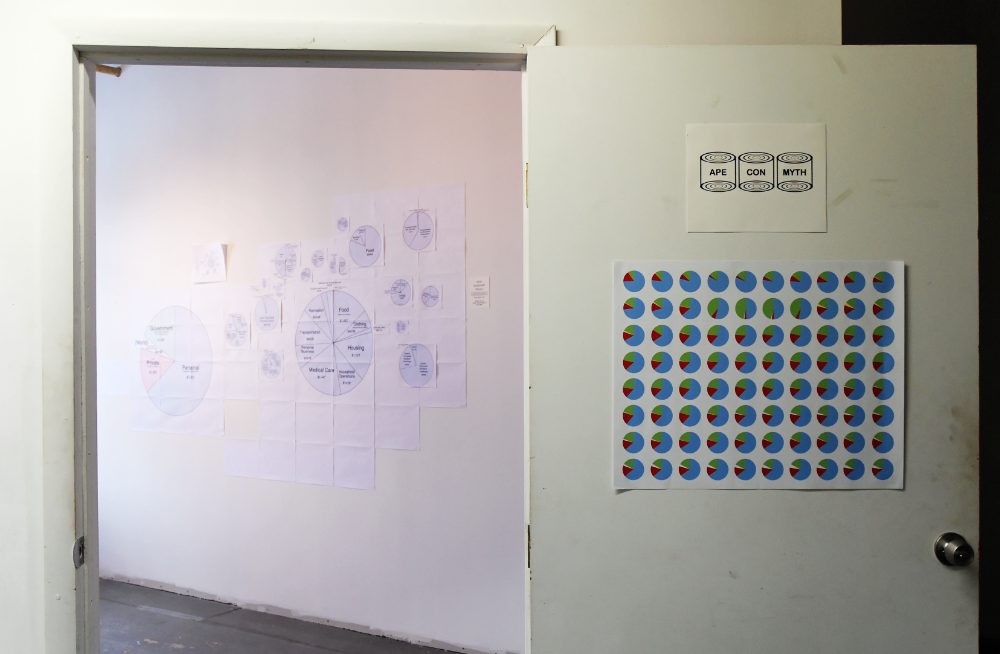
    View into my second studio (dubbed the John Nash studio) in Red Hook, Brooklyn.
    The pie charts on the door and wall are United States national economic account data.

    My story of working with data goes back much further though.

    I was fascinated by numbers at an early age.

    But far from being able to claim any understanding of it, I think initially I might have been drawn to finance simply from the daily stock market report flashing numbers with strange abbreviations in front of me.

    I didn’t know what any of it meant, but it looked like fun, and thanks to shows like Family Ties and movies like Wall Street, the mirage of the markets got me out the door, to New York City and business school.

    As it went though, I was disillusioned by the whole thing on the first day of Economics 101.

    All it took was seeing the supply and demand curves for me to think better of it all.

    Supply and demand are too easily manipulated for it to be the basis of so much, especially when it comes to the way we make our living and attempt to survive.

    Ironically, it was leaving business school to study dramatic writing and literature that eventually led me back to my own study of economics, as I literally and figuratively struggled with the concept of making a living firsthand.

    That was ultimately the genesis of Ape Con Myth, which operated under the header: “the struggle for survival is an incredible waste of time.”
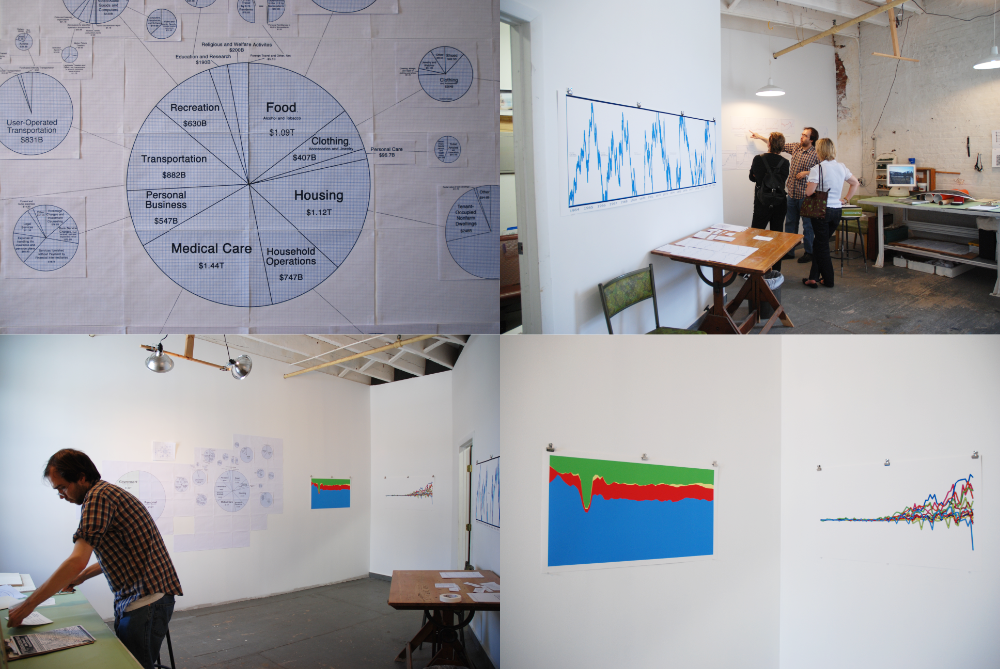
    This was my setup for an open studio day in Red Hook back in 2009. We’ve got personal consumption expenses in the top left pie, the Dow Jones in the top right, and the green dip you see in the bottom right corner image is government spending during World War II.

    The premise that we are wasting our lives trying to make a living has only grown more concrete in my mind, from both personal experience and paying attention to the world around me.

    Look at us. Look at this mess. We aren’t even trying to make it easier on ourselves.

    Supply and demand are getting the best of us all, and it warps the spacetime of our lives every day.

    That is in effect why I’m here. That is why everything you see on this site is happening.

    We needlessly suffer and struggle. I don’t think it has to be like that.

    What do you think?
  • The Civilian Noninstitutional Population

    The Civilian Noninstitutional Population

    This is one of my favorite concepts in United States’ economic data.

    It cuts right to the inhumanity of it all.

    Who is part of the Civilian Noninstitutional Population (CNP)?

    Well, if you are at least sixteen years of age, not in the military, and not living in an institutional facility, … you are!

    Why do we split it up as such?

    It always feels like a dodge to me. When navigating this type of data, there are always these little exceptions that muddy the water, technically true and relevant, but with some dampening effect to the clarity and impact of the associated concepts.

    In that regard, CNP represents one of many obstacles to a basic understanding of the U.S. economy.

    Take for instance recent headlines about drops in the labor force. It doesn’t sound good, but the media perpetually throws out numbers without the context needed to understand them.

    This is the beginning of a series of posts attempting to establish that context.

    First we will consider the finite set of the U.S. population.

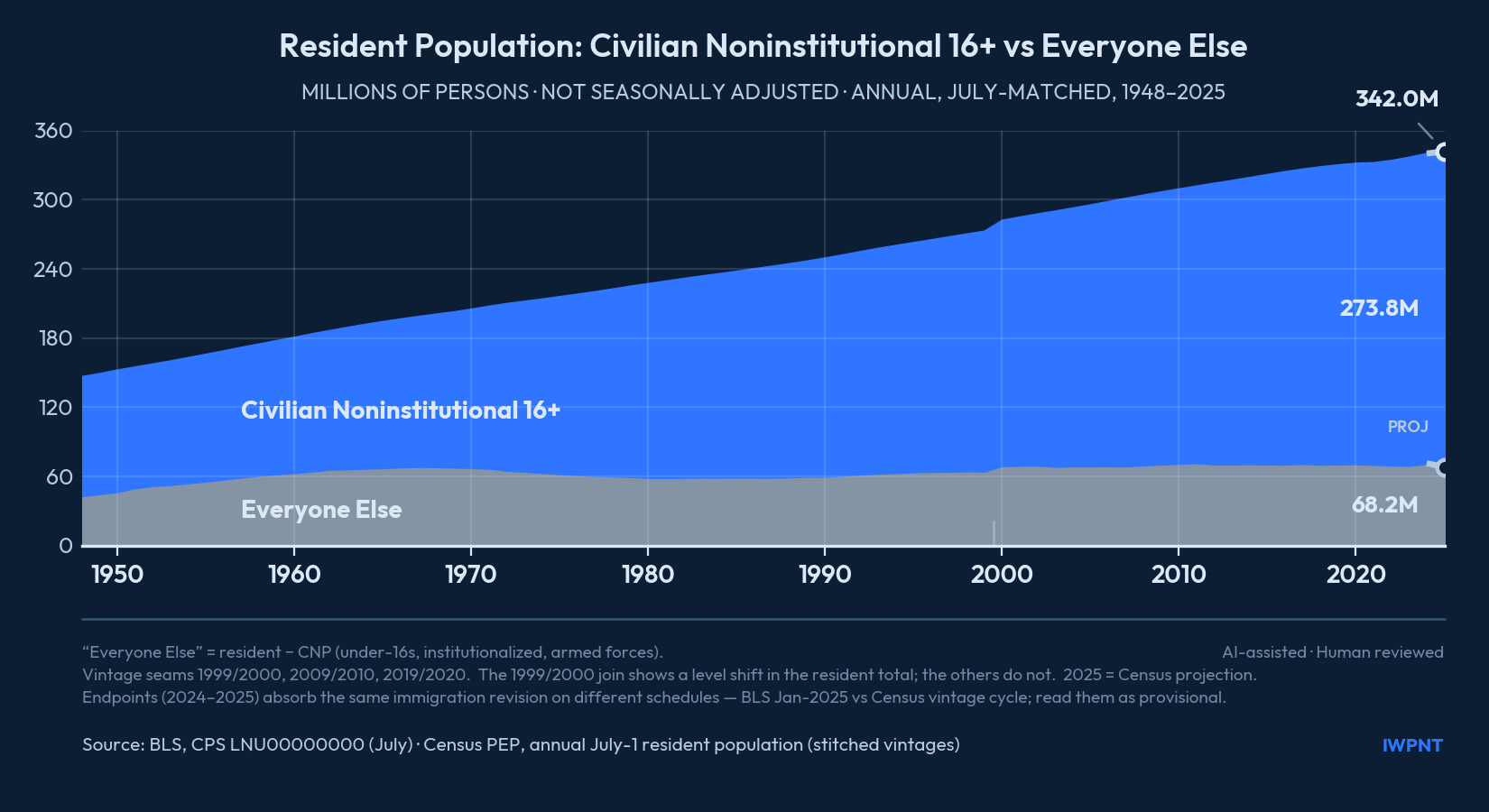
    To find our labor force and understand its drop, this first cut divides our resident population by availability to join the labor force, which is basically what the Civilian Noninstitutional Population represents.

    And yes, “Everyone Else” is overwhelmingly children (~94%), plus those in the military and institutions.

    Notice anything funny about Everyone Else?

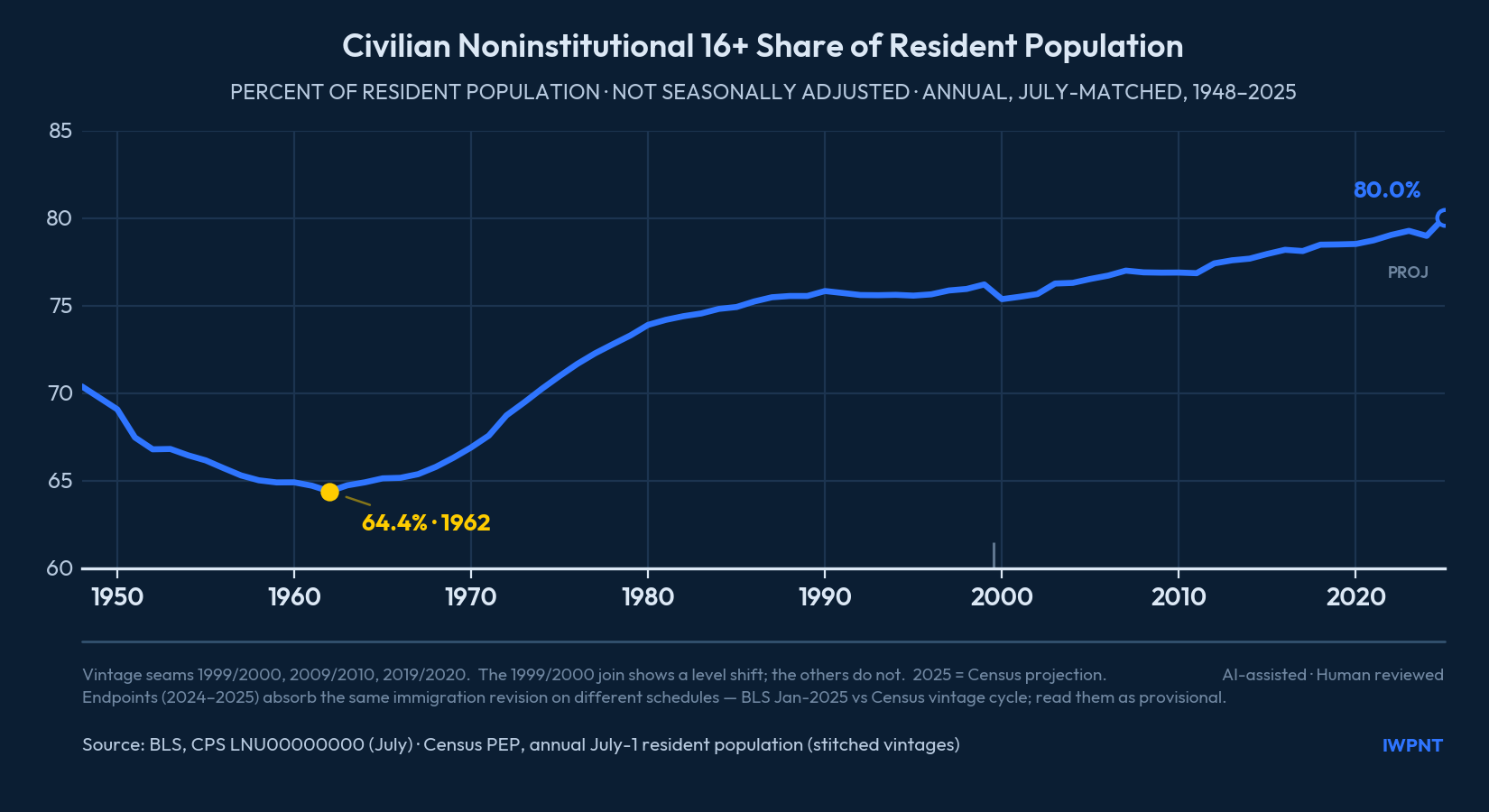
    It has not been growing. Look at that timeline. In 1970 there were 67.9 million in the Everyone Else bucket versus a projected 68.2M in 2025, which is 0.4% growth for the period.

    Over the same time, the Civilian Noninstitutional Population has roughly doubled from 137.2M to 273.8M, or 99.6% change overall.

    What happened? Or what didn’t happen?

    It would seem the widely publicized “baby boom” has been followed by a long, slow baby bust.

    The baby boom’s impact peaked in this regard back in 1962.

    Was the youth culture of the 1960s literally driven by the power of numbers?

    It would seem then that the 1970s was not just a coming of age story for that lot, but one for the country as a whole as it began shifting to a heavier mix of adults, which has continued into the present.

    Projected at 80% as of 2025, the CNP now outnumbers Everyone Else by 4 to 1, up from the 3 to 1 ratio breached in the 1980s.

    If it feels less fun around here, you now know one more reason why.

    And since the rest of this journey mainly focuses on breaking down CNP, let’s answer the question begging to be answered and quantify the kids in this story while we are here.

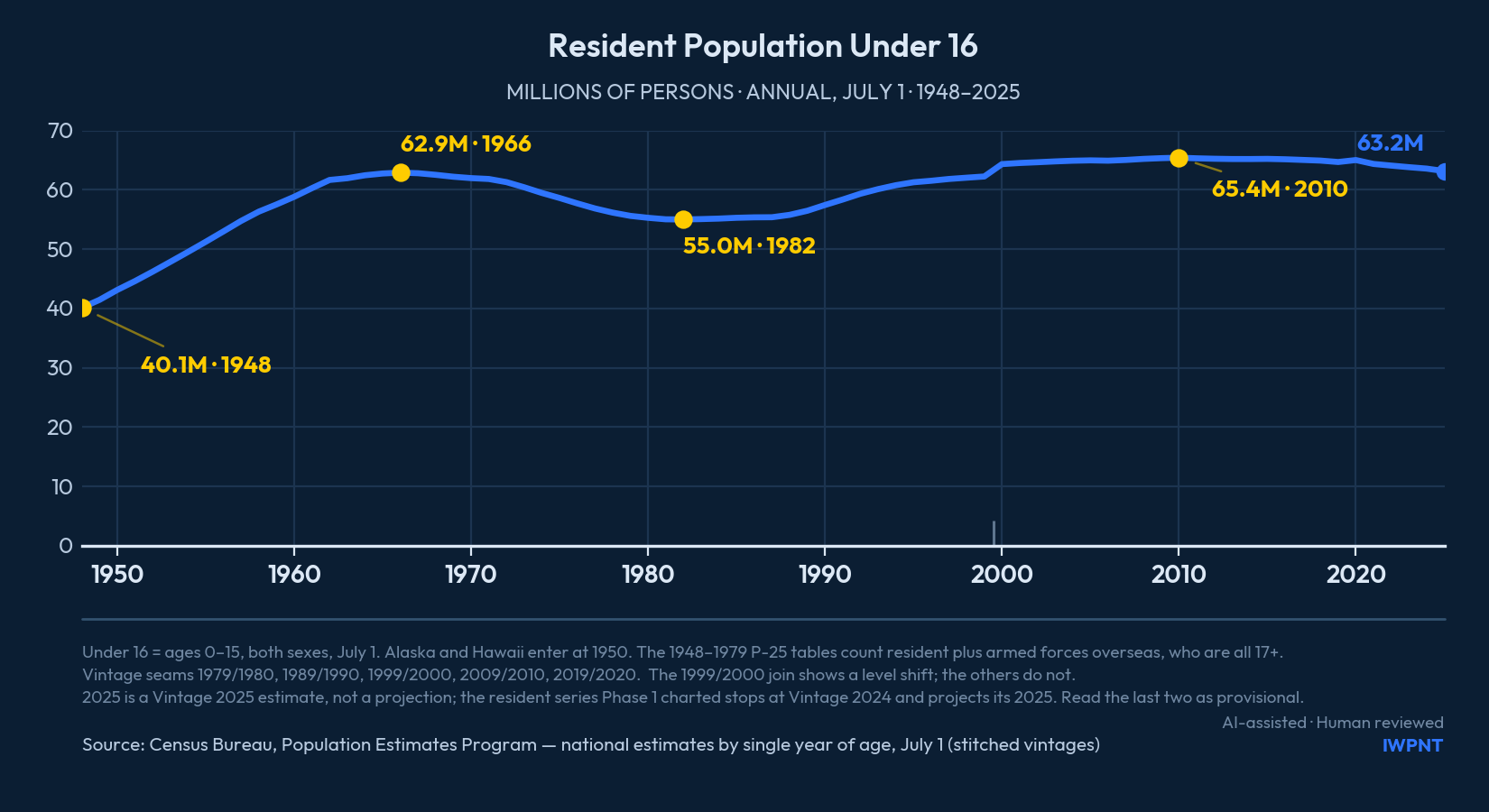
    Line chart of the U.S. resident population under age 16, in millions, 1948–2025. It rises from 40.1 million in 1948 to a baby-boom peak of 62.9 million in 1966, falls to 55.0 million in 1982, recovers to a second peak of 65.4 million in 2010, and drifts down to 63.2 million by 2025.

    There’s your baby boom. From 40M kids to 60M in a little over a decade. It has basically been flat since, with a dip in the 1970-80s making it a little less unnerving to see that number sliding again now.

    2025 America had basically the same number of kids as in 1966, except kids today have to deal with twice as many adults.

    So it has gone.

    Later we will get to the household data that might connect those kids with the adults dropping out of the labor force.

    Next however we will break down the Civilian Noninstitutional Population into parts.

    What percentage of those available to work are working? Who needs work and doesn’t have it? And how do those populations fit into the whole?

  • Creating in a laboratory of one’s self

    Creating in a laboratory of one’s self

    To create… well, with my brand of creation at least, … it is like working in a laboratory of one’s self.

    I am here this morning surrounded by all my lab equipment, my past work, and my active experiments, which take the form of the files and windows open and stored on all these computers, the papers on the wall and in all these boxes and drawers, and all the things swirling around in my head that haven’t made it out yet.

    It is a wonderland.

    But in the larger scope of things, there is always my life, which impacts the disposition and flow in this lab.

    Time spent is the precious commodity, and what I have to spend it on often overwhelms and displaces what I would like to spend it on.

    Everything goes in phases though.

    This is a self-conscious one for me.

    A time of renewal and recalibration.

    It’s not the first time I’ve been here. I know this place because it usually coincides with me returning to the Tao Te Ching.

    D.C. Lau’s 1963 translation is my preferred version, and it begins…

    The way that can be spoken of
    Is not the constant way;
    The name that can be named
    Is not the constant name.

    As a generalist, I have had an easier time connecting with these two simple yet daunting concepts that stand at the beginning of this work.

    For someone who somewhat needs and seems to thrive in a basic routine, my every day, every week, and every month are nothing but different. It doesn’t matter how consistent the schedule is, the experience is never the same. Even when I like and particularly note a pattern, I cannot seem to repeat it.

    But I’ve been reading those words above over and over again since high school and I do like to think that part of my operating system has been written with them in mind.

    Who can keep up with the ideas that are actually sticking over time though?!

    The nameless was the beginning of heaven and earth;
    The named was the mother of the myriad creatures.

    These two lines are easy to pass over, perhaps because of the rug that they pull out from under us, said myriad creatures. We didn’t come with names, we were given them.

    We have given names to everything we could think to name, while not knowing what we were missing.

    And that’s where these next two lines come in. They identify the self-conscious moment I’m in right now…

    Hence always rid yourself of desires in order to observe its secrets;
    But always allow yourself to have desires in order to observe its manifestations.

    There is it. The precious moment I’m having is being rid of any specific desires for a moment.

    “Allowing” myself to have desires is not often a choice, once an idea takes hold.

    The Papercuts Library is in effect a tunnel I’m emerging from after nearly seven years.

    So many forces shaped the reasoning that led me there. And as a vehicle, it has served me well in its purpose. … It is not going away either. … However I am in the midst of shifting my creative center of gravity.

    I have long preferred not to utilize this website for reasons we will be exploring along the way, but for the moment, suffice to say, I’m stepping out of the vehicle of a book series and into the vehicle of myself.*

    My laboratory … or whatever this existence is and represents.

    But sitting here without desire, I am observing the secrets of The Way. … And I’m trying to learn what I can, while I can, because I know soon enough an idea will take hold and I will be off on my merry and directed way toward a new destination, observing its manifestations.

    What I haven’t cracked yet is the end of this first chapter:

    These two are the same
    But diverge in name as they issue forth.
    Being the same they are called mysteries,
    Mystery upon mystery –
    The gateway of the manifold secrets.

    So you are never without The Way, whether driven mad by desire or sitting there like a rock.

    This faucet is always on.

    Being aware of that is the key, and the challenge.

    There are eighty more chapters to this amazing work if you are interested in being challenged as such.

    I cannot recommend it more.

    In my copy you can still see the six or so lines I highlighted back in high school. They were the only ones I felt I understood at the time.

    Even now, I wouldn’t necessarily claim to understand any of it, while also feeling that I am helplessly living it in more ways than I’ve ever noticed or imagined.

    It’s that kind of thing.

    You can’t put a name on it.

    Embrace that.

    *It’s all in the packaging, folks.

    There it is, you don’t even need the rest of the book.